Realistic and experimental worlds
Four environments wrap an external simulator or dataset. They get a short entry
rather than a full guide because you cannot run any of them after
pip install POMDPPlanners alone: each needs a separate install, and two need a server process.
They also differ from the rest of the package in kind. A benchmark environment
is both the world and the planner’s model of it. These are forward-only
adapters: they can step the world, but they cannot serve as a planner’s
generative model, and their transition_log_probability /
observation_log_probability raise NotImplementedError. You plan on a
separate approximated model and execute in the simulator — see
Running Simulations.
None of them appear in ENVIRONMENT_REGISTRY, so get_environment will not
build them, and they are outside the cross-environment API conformance suite.
Formal definition
These four are not POMDPs in the sense the rest of the catalog is. The tuple \(\langle S, A, Z, T, O, R, b_0, \gamma \rangle\) still describes what they do, but \(T\) is not available in closed form and has no density:
\(T\) is the simulator — a physics engine, a traffic model, or a
recorded log with reactive agents. Consequently
transition_log_probability and observation_log_probability raise
NotImplementedError, and \(b_0\) is a single realized reset rather
than a distribution you can sample repeatedly. You do not plan on these. You
plan on a separate approximated model \(\tilde{T}\) whose density is
computable, and execute the chosen action here — see
Running Simulations.
Two further departures matter:
The world is stateful and forward-only. There is one live state, and
sample_next_state(s, a)advances it. Querying from any \(s\) other than the live one raises. So \(T\) is not even a function you may evaluate at arbitrary points — a tree search cannot expand here at all.Termination is a property of the live world, not a predicate on a state vector.
is_terminalrefuses a state other than the current one.
What this page does state is \(S\), \(A\), \(Z\) and, for CARLA and nuPlan, \(R\).
Driving reward (CARLA and nuPlan). Both use the same gym-carla-style score. Let:
\(\mathrm{yaw}\) be the ego yaw;
\(e_{\mathrm{yaw}}\) the heading error;
\((v_x, v_y)\) the velocity;
\(d\) the lateral offset from the route.
The along-route speed is
The reward also uses:
steering command \(u\);
desired speed \(v_{\text{des}}\) =
desired_speed;lane-offset limit \(d_{\max}\) =
out_lane_thresh.
Then:
The last two terms are CARLA’s; nuPlan carries the collision term without the success bonus. Note \(R\) rewards speed linearly and then penalizes exceeding \(v_{\text{des}}\) by a flat \(-10\), so the optimum sits just under the limit; the \(|u| v_\parallel^2\) term is what discourages fast turns specifically rather than turning in general.
Isaac Lab is the one wrapper whose observation is not the state,
\(o = h(s) + \text{noise}\) — state read from the physics engine,
observation from a sensor buffer. Its \(R\) passes through from the
underlying task, so there is no declared reward_range and no closed form
this page can state.
Racetrack
RacetrackPOMDP
wraps HighwayEnv’s racetrack-v0. It needs the least setup of the four — one
pip install highway-env, no server.
Its point is the matched pair: one dynamics, reward and track, with two
observation configurations selected by ObservationMode.MDP or
ObservationMode.POMDP. A planner’s score gap between the two isolates the
cost of partial observability with everything else held fixed. No other
environment in the package is built for that comparison.
Discrete actions over control presets, continuous observations. highway-env
is imported lazily and is declared in the dev extra, so CI runs
highway-env itself while a runtime install never loads it.
CARLA
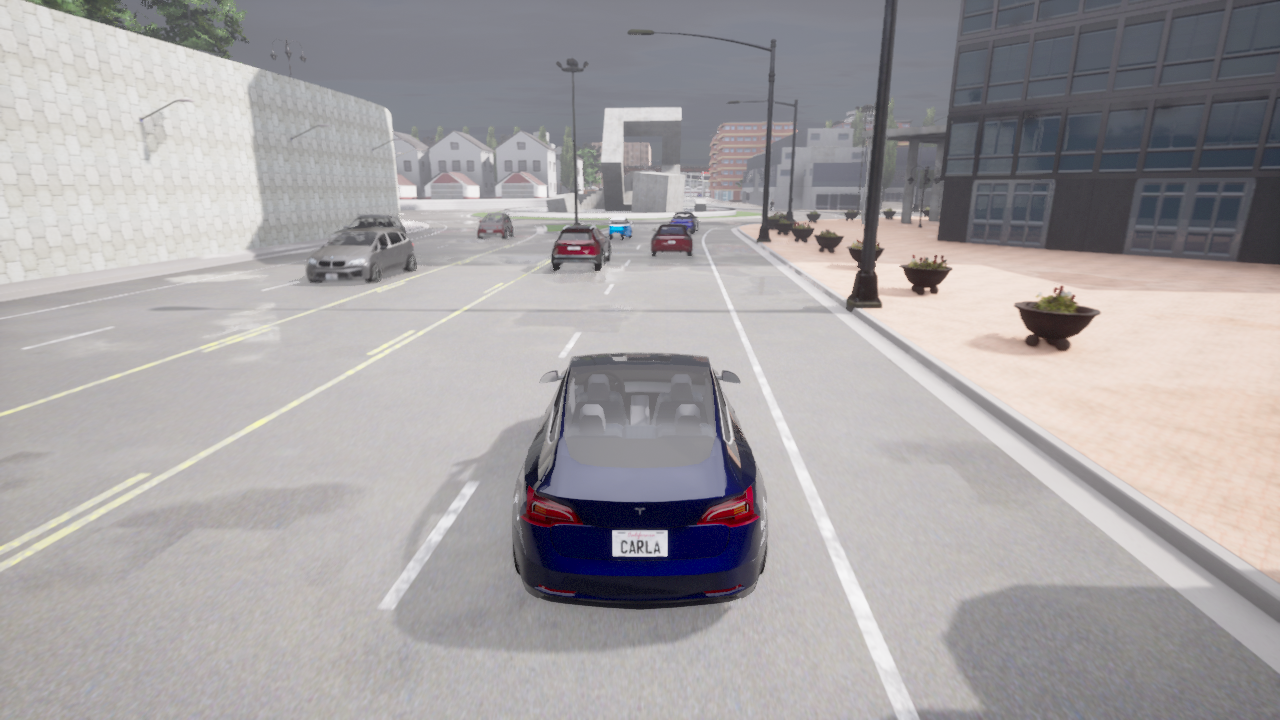
CarlaPOMDP drives a running
CARLA server as the ground truth of an episode.
State — a flat vector of width
7 + 5·max_tracked_agents + 5 + 3: ego[x, y, yaw, vx, vy, lateral_offset, heading_error](yaw in degrees, CARLA’s convention), thenmax_tracked_agentsslots of[present, rel_x, rel_y, rel_yaw, rel_speed]in the ego frame, then a traffic-light slot[present, rel_x, rel_y, state_code, time_to_change], then a goal slot[goal_x, goal_y, route_progress_fraction].Actions (discrete) — an index into
(throttle, steer, brake)presets; four by default.Observations — declared
CONTINUOUS, but returned as a dict of sensor payloads. A defaultCarlaPOMDP()emits all five:gnss,agents,camera,lidarand a privileged ground-truthtraffic_light.include_camera,include_lidarandinclude_traffic_lightall default toTrue, so these are opt-out, not opt-in.Rewards — driving quality:
+1.0 ×along-lane speed,-10.0overspeed,-1.0out of lane,-5.0 × steer²,-0.2 × |steer| × speed²,-0.1per step, with-100.0on collision and+100.0at the destination.
Requires the carla Python API (imported lazily, and not declared in
pyproject.toml) and a running CARLA server, localhost:2000 by default.
CarlaServerPool manages several headless servers for parallel episodes.
Planner-side models, all pure NumPy with no CARLA import:
KinematicCarlaModelPOMDP— kinematic-bicycle ego transition. Prefer this one.FactoredCarlaModelPOMDP— its transition is a documented identity placeholder, so every action looks motionless to the planner.DreamerCarlaModelPOMDP— a trained Dreamer RSSM behind a protocol.
Isaac Lab
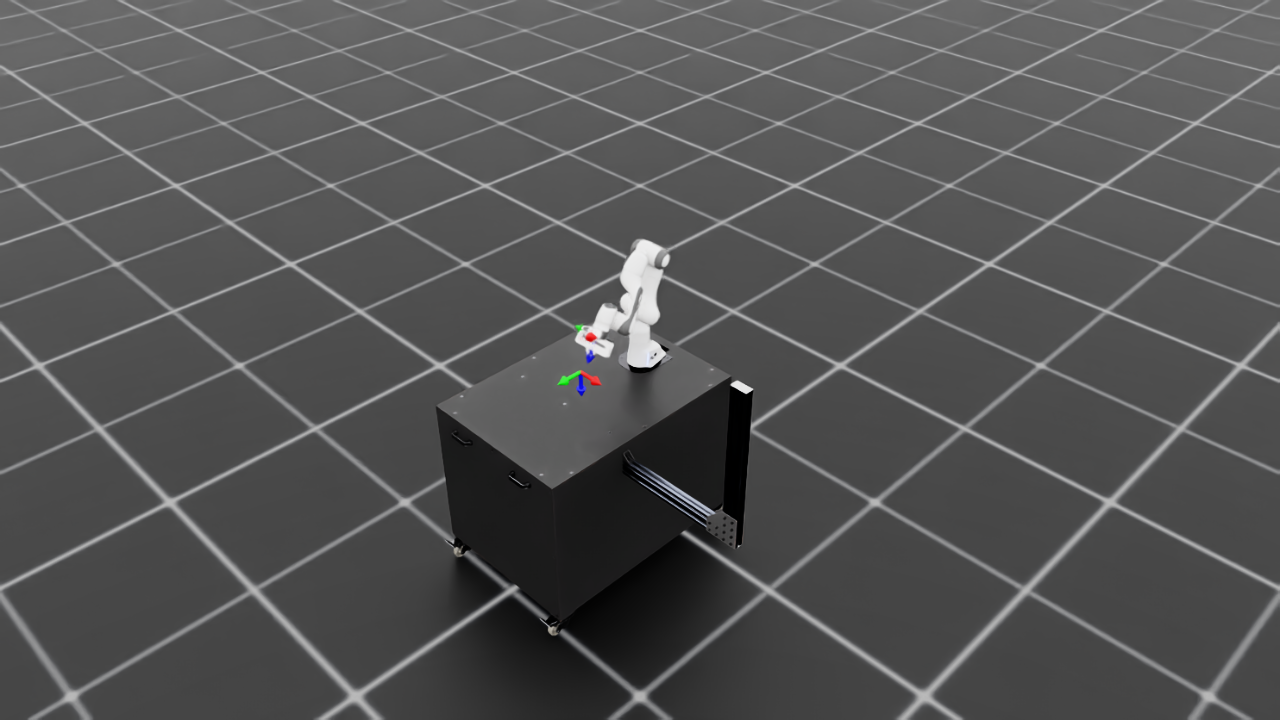
IsaacLabPOMDP
adapts any registered Isaac-*-v0 task, and is the one wrapper whose
observation is not the state, observation = h(state): state is read from the physics engine, the
observation from a sensor buffer such as a RayCaster LiDAR.
Alone among the environments, its space types are constructor arguments —
action_space_type and observation_space_type, both defaulting to
continuous. Reward passes through from the underlying task, so there is no
declared reward_range unless you supply one. Success rate needs an explicit
success_termination_term or success_extractor. With neither, success is
not measured, and a term name the task does not have raises RuntimeError
instead of inferring success from termination.
Two constraints shape how you can use it:
One ``SimulationApp`` per process. The world and the planner’s model cannot both be Isaac Lab in-process, and multiprocessing task managers cannot fork it.
``num_envs`` must be 1. The constructor raises otherwise.
Needs Isaac Sim, Isaac Lab and a GPU; isaaclab and isaaclab_tasks are
imported lazily.
Planner-side models come in two stacks:
The factored one —
FactoredIsaacModelPOMDPwith the task-specificUnicycleIsaacModel,ManipulatorIsaacModel,NavigationIsaacModelandLearnedIsaacModel— splits the state into named channels, each observed through its own model, so a channel with no observation model stays hidden. Prefer it.The one-space
IsaacLabModelPOMDPshares one space between state and observation withobservation = state + N(0, Σ); it is generic but cannot express a hidden state variable, and its default reward model isNone, meaning flat zero reward and undirected planning.
nuPlan
NuPlanPOMDP runs
closed-loop on recorded nuPlan scenarios, with the same world/model split and
the same driving-quality reward as CARLA. Ego state uses the same seven-slot
layout, with yaw in radians rather than degrees. Discrete actions over
(acceleration, steering_angle) presets; observations are a
{ego, agents} dict.
Needs nuplan-devkit (imported lazily, not declared in pyproject.toml)
plus the nuPlan dataset and maps. Models: KinematicNuPlanModelPOMDP and
FactoredNuPlanModelPOMDP.
See also
Base Environment Class — the full catalog.
Running Simulations — running a planner on an approximated model while the episode executes in the simulator.